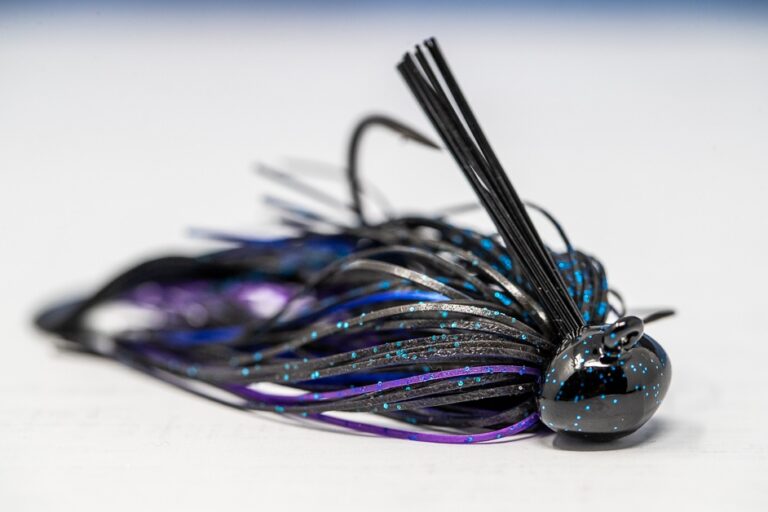
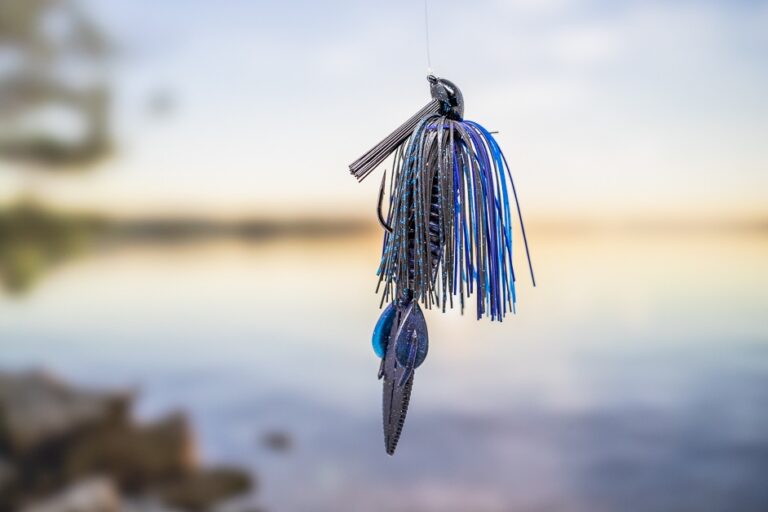
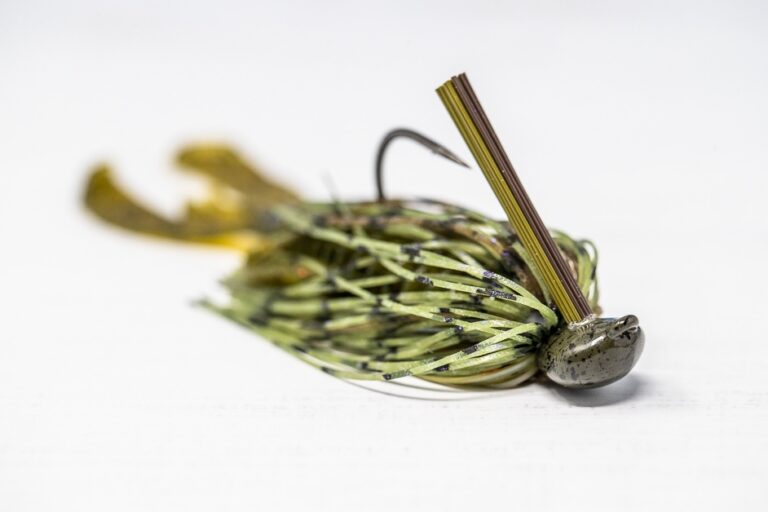
Swing Head Jig
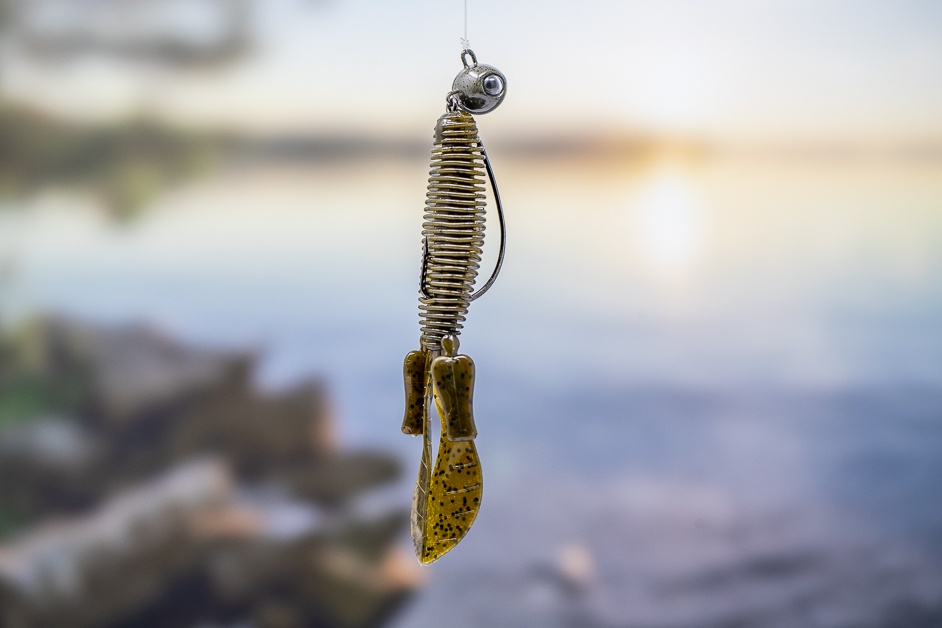
A swing head jig is a football-shaped head joined to the hook by a loose link, so the hook and the bait swing freely behind it. You do not hop it or drag it. You reel it steadily along the bottom, like a crankbait, and the bait wobbles and kicks as the head bumps over rock. It is also sold as a wobble head or hard-head jig.
- Skill levelIntermediate
- Best forLargemouth, smallmouth and spotted bass
- Where it shinesGravel, rock, shell, hard points and flats
- Depth3 to 25 feet
- SeasonLate spring through fall
- SpeedSteady, medium
What a swing head jig is
On an ordinary jig the hook is molded into the head. Here the two are separate, joined by a small ring or wire loop. The head does the work of staying on the bottom, and the bait behind it is free to rock from side to side every time the head tips over a stone.
There is no skirt and no weed guard. The bait is a soft plastic craw or creature, rigged on the hook with the point hidden, the same way as a Texas rig.
What you need
| Item | Start here | Adjust |
|---|---|---|
| Head | 1/2 oz swing head with a 4/0 hook | 3/8 oz in less than 8 feet. 3/4 oz past 15 feet or in wind |
| Bait | 4 inch soft plastic craw or creature bait | A flat-bodied bait wobbles the most. A worm gives a slimmer look |
| Line | 15 to 17 lb fluorocarbon | It sinks and holds up to rubbing on rock |
| Rod | 7 ft 3 in medium-heavy casting rod, fast action | The same rod you would use for a football jig |
| Reel | Baitcasting reel, about 6:1 or 7:1 | A medium-speed reel makes a slow, steady pace easier to hold |
Rig it in 3 steps
- Start at the nose. Push the hook point into the center of the nose of the bait, go in a quarter inch and bring it out the side. Slide the bait up to the eye and turn the hook.
- Hide the point. Lay the hook alongside the bait, push the point through at the bend and rest the tip just under the skin on the far side.
- Check it. The bait must hang dead straight. Crooked, it spins instead of wobbling.
Choosing a head weight
The head has to stay on the bottom while you reel. If it lifts off, go heavier or slow down.
| Weight | Use it when |
|---|---|
| 3/8 oz | Less than 8 feet |
| 1/2 oz | The all-purpose size, 8 to 15 feet |
| 3/4 oz | Deeper than 15 feet, wind, or a faster retrieve |
How to fish it: three retrieves
Reel it
The standardMake a long cast, let it reach bottom, point the rod at the lure and reel slowly and steadily. You should feel the head ticking over the bottom the whole way.
Stop and go
When it bumps somethingEach time the head knocks into a rock, stop for a second and then start again. Fish often take it as it pulls away.
Drag it
Cool water, slow fishPull it along with the rod a foot at a time and pause, the way you would fish a football jig.
What a bite feels like
The steady ticking stops, the lure gets heavy, or you feel a thump. Keep reeling until the rod loads up, then sweep the rod firmly to the side.
Use a swing head when you want to cover a lot of hard bottom quickly and the fish are active. Use a football jig when you have found the fish and need to slow down and work one spot.
This lure needs a firm bottom. On a pond, that usually means the face of the dam, a gravel point, or a sandy swimming area. Cast along it with a 3/8 oz head and reel slowly. On soft mud or in weeds it just plows in, so use something else there.
Color: keep it simple
Green pumpkin almost everywhere. Brown with orange around rock in spring. Black and blue in stained water.
Common mistakes and the fix
- Reeling too fast. The head lifts off the bottom and the lure stops working. Slow down until you feel it ticking again.
- Head too light. If it will not stay down at a slow pace, go up a size.
- Fishing it in grass or brush. The wide head catches. Keep it on rock, gravel, shell and sand.
- Bait on crooked. It spins and twists your line. Rig it again until it hangs straight.
- Setting the hook upward. Keep reeling and sweep to the side, so you pull the hook into the fish and not up and away from it.
Watch it done

Video: Swinging Jigs For Summer Bass – Everything You Need To Know, by TacticalBassin on YouTube.
Common questions
Why does the hook swing freely?
Two reasons. The bait moves more, because it is not held rigid by the head. And a hooked fish has a harder time shaking loose, because it cannot use the weight of the head as a lever against the hook.
Is it the same as a wobble head or a hard-head jig?
Yes. Those are other names for the same design.
Can I change the hook?
On most swing heads the hook comes attached. Some have a clip that lets you swap in a different size.
Keep learning
General guidance, not a guarantee of a catch. Follow state fishing regulations and your host’s lake rules. Sizes and line weights are common starting points used by bass anglers; adjust for your water.