Underspin Lure

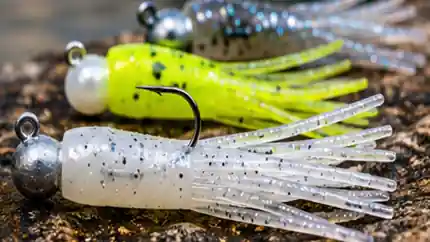
An underspin is a jighead with a small spinning blade hanging underneath it, fished with a soft swimbait on the hook. It gives you the flash of a spinner and the shape of a single small baitfish. It is at its best in cold, clear water, when bass are holding off the bottom around schools of bait and will not chase a bigger, louder lure.
- Skill levelBeginner to intermediate
- Best forLargemouth, spotted and smallmouth bass
- Where it shinesPoints, steep banks, open water near baitfish
- Depth5 to 30 feet
- SeasonLate fall through early spring
- SpeedSlow and steady
What an underspin is
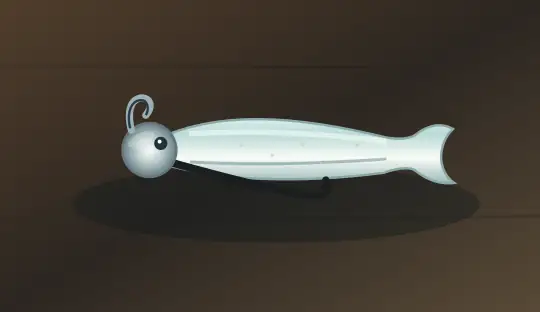
The head looks like a small fish head, often with an eye painted on. A short wire and a tiny swivel under the chin hold a slim metal blade. As the lure moves, or falls, the blade turns and throws off small flashes, like light catching the side of a baitfish.
Because the blade is small and tucked under the head, the lure stays compact and runs true at very slow speeds. That is what sets it apart from a spinnerbait.
What you need
| Item | Start here | Adjust |
|---|---|---|
| Underspin head | 3/8 oz | 1/4 oz in less than 10 feet. 1/2 oz past 20 feet or in wind |
| Bait | 3 to 4 inch paddle-tail swimbait | A straight-tailed soft jerkbait in very cold water, for less movement |
| Line | 10 to 12 lb fluorocarbon | 8 lb on spinning gear with a 1/4 oz head |
| Rod | 7 ft medium or medium-heavy rod with a softer tip | A softer rod keeps small hooks in on a slow, steady pull |
Rig it in 3 steps
- Measure first. Hold the bait beside the head and note where the bend of the hook ends.
- Thread it on. Push the hook point into the center of the nose, run it straight down the middle and bring it out of the back at your mark.
- Check it. The bait should lie straight with the tail down, and the blade should swing freely under the head.
Choosing a head weight
| Weight | Use it when |
|---|---|
| 1/4 oz | Less than 10 feet, or fish close to the surface |
| 3/8 oz | The all-purpose size, 10 to 20 feet |
| 1/2 oz | Deeper than 20 feet, wind or current |
How to fish it: three retrieves
The one rule is to go slowly. Reel only fast enough to feel the blade turning.
Count down and reel
Fish holding off the bottomCount as the lure sinks, then reel slowly and steadily at that depth. Change the count until you get bit, then repeat it.
Along the bottom
Points and rocky banksLet it reach bottom and reel so it stays a foot or so above. If you stop feeling the bottom now and then, slow down.
Lift and fall
Cold water, fish under the boatLift the rod a couple of feet, then let the lure sink on a tight line. The blade keeps turning as it falls, and that is when fish take it.
What a bite feels like
Usually the lure just gets heavy, as if you have picked up a wet leaf. Keep reeling and lean into it with a steady sweep. A hard, sudden hook set tends to pull the lure away.
Season by season
| Season | Where | How |
|---|---|---|
| Winter (below 50°F) | Steep banks, deep points, around schools of baitfish | Count down and reel very slowly. The best time for this lure |
| Pre-spawn (50 to 60°F) | Points and channel bends leading to spawning areas | Along the bottom |
| Summer (80°F and up) | Deep, open water over points and humps | Count it down to fish you can see on a sonar screen |
| Fall (cooling) | Creek arms and points where shad gather | Count down and reel under the baitfish |
An underspin is a clear-water, open-water lure. On a clear pond in the cooler months, cast a 1/4 oz head toward the deep end and bring it back slowly. In weedy or muddy ponds, a spinnerbait or swim jig is a better fit.
Color: keep it simple
White, pearl or a silver shad color for the swimbait, with a silver blade in clear water and a gold blade when it is cloudy or the water has some color.
Common mistakes and the fix
- Reeling too fast. This is a slow lure. If it is rising toward the surface, slow down.
- Fishing it in weeds or brush. The hook is exposed and the blade tangles. Keep it in open water.
- Setting the hook hard. Keep reeling and sweep.
- Not counting. Depth matters more than anything with this lure. Count it down on every cast so you can repeat what works.
- Bait on crooked. It rolls and the blade fouls. Rig it again, straight.
Watch it done

Video: Underspin Bass Fishing – Everything You Need To Know, by TacticalBassin on YouTube.
Common questions
How is an underspin different from a spinnerbait?
A spinnerbait has larger blades on a wire arm above the hook, and a skirt. It is bulkier, louder and more weedless. An underspin is smaller and quieter, with one little blade under the head, and it suits clear, open water.
Can I use it without a blade?
Then it is simply a swimbait on a jighead. See soft swimbaits.
Does it work in warm water?
Yes, especially for bass feeding on small baitfish in open water. It is best known as a cold-water lure because it still gets bites when little else does.
Keep learning
General guidance, not a guarantee of a catch. Follow state fishing regulations and your host’s lake rules. Sizes and line weights are common starting points used by bass anglers; adjust for your water.