
Sockeye and Kokanee Salmon
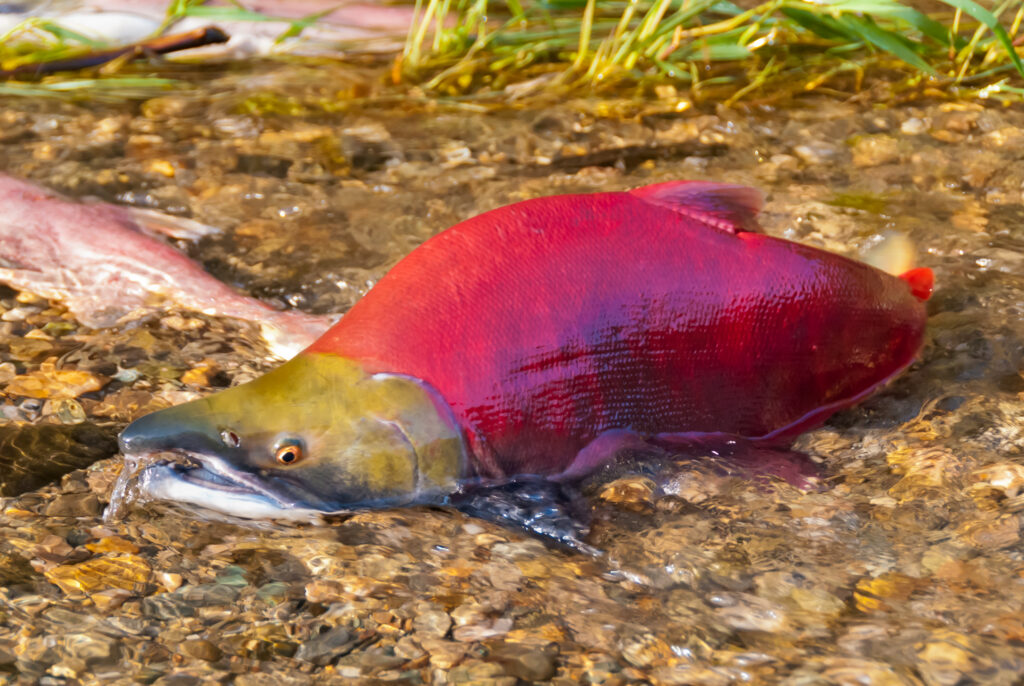
Sockeye and kokanee are the same fish living two different lives. Sockeye go to the ocean and come back to rivers as 4 to 8 pound salmon. Kokanee never leave fresh water and spend their whole lives in cold, deep lakes across the West. Both feed mainly on plankton, so catching them takes a different approach from other salmon.
- Scientific nameOncorhynchus nerka
- Also calledRed salmon, blueback, silvers, kokes
- Typical sockeye20 to 26 inches, 4 to 8 lb
- Typical kokanee10 to 16 inches, under 2 lb
- World recordsSockeye 15 lb 3 oz, kokanee 9 lb 10 oz
- SpawnsLate summer and fall, then dies
How to identify a sockeye or kokanee
- No big spots. A bright fish is silver with a blue-green back and no large black spots on the back or tail. Chinook, coho and pink salmon all have them.
- Spawning colors. As they near spawning the body turns bright red and the head turns green. Males grow a humped back and a hooked jaw.
- Size tells you which one. A 12 inch adult in a lake is a kokanee. A 5 pound fish in a river that runs to the sea is a sockeye.
| Sockeye or kokanee | Coho | Chinook | Pink | |
|---|---|---|---|---|
| Spots on back | None, or fine specks | Small black spots | Large black spots | Large oval spots |
| Spots on tail | None | Upper half only | Both halves | Large ovals, both halves |
| Spawning color | Red body, green head | Dark red sides | Olive brown to dark | Gray, big hump on males |
How big do they get?
Sea-run sockeye average 4 to 8 pounds. Kokanee are far smaller because a lake holds less food than the ocean: 10 to 16 inches is normal, and the size changes from year to year with how many fish share the lake.
The IGFA all-tackle records are 15 pounds 3 ounces for sockeye, from the Kenai River, Alaska, in 1987, and 9 pounds 10 ounces for kokanee, from Wallowa Lake, Oregon, in 2010.
Where they live
Sockeye
Rivers with a lake somewhere upstream, because the young grow up in lakes before going to sea. Alaska has the big runs: Bristol Bay, the Kenai and Russian rivers and the Copper River. Washington has smaller runs, including the Columbia River and Baker Lake.
Kokanee
Cold, clear, deep lakes and reservoirs in Washington, Oregon, Idaho, Montana, California, Colorado, Utah and Wyoming. They school in open water, not along the bank, and follow a band of water near 50 to 55°F.
Kokanee hold at one depth as a school. Use sonar to find the marks, then run every lure at that depth or just above it. They look up to feed.
Sockeye need a river with a lake upstream and a route to the sea, so they are never a pond fish. Kokanee are stocked in a few large, deep, cold private lakes in the West, but they need open water that stays cold all summer and gravel streams or shorelines to spawn, so most lakes are restocked. If a host lists kokanee, ask whether a boat with sonar is available.
What they eat
Plankton, the tiny animals drifting in open water, which they strain with fine comb-like gill rakers. That is why you cannot simply match the bait. Kokanee strike small, bright, scented lures out of reflex and aggression. Sockeye in rivers have stopped feeding altogether.
Season by season
| Season | Kokanee in lakes | Sockeye in rivers |
|---|---|---|
| Spring | Near the surface, top 20 feet. Easy to reach without special gear | Still at sea |
| Summer | Deep, often 30 to 80 feet, in the cool band of water. The fish are at their biggest | Runs enter the rivers, mostly June through August in Alaska |
| Fall | Mature fish turn red, gather off stream mouths and gravel shores, spawn and die | Spawning in streams and along lake shores |
| Winter | Younger fish school deep. Caught through the ice by jigging | None in the rivers |
How to catch them
Kokanee: troll slowly
- Rig a dodger and a small lure. A dodger is a metal blade that flashes and swings. Tie a small pink or orange squid lure, spinner or spoon 8 to 14 inches behind it.
- Tip the hook with corn. One or two kernels of white corn add scent. It is the standard kokanee bait across the West.
- Go slow. Troll at 1 to 1.8 miles per hour and make gentle S turns.
- Get to their depth. Use a downrigger, lead-core line or added weight to reach the marks on your sonar.
- Play them softly. Kokanee have soft mouths and tear free easily. Use a limber rod and a light drag, and net every fish.
Sockeye: drift the line to them
In Alaska rivers, sockeye travel close to the bank in a steady line. Anglers swing a small sparse fly on a short leader with a weight along the bottom so it meets fish as they pass. Only a fish hooked in the mouth may be kept. Any other fish must go back at once.
Starter gear
| Item | Kokanee | Sockeye |
|---|---|---|
| Rod | 7 to 8 ft light, soft-tipped trolling rod | 9 ft medium-heavy spinning or 8 weight fly rod |
| Line | 8 to 10 lb monofilament | 20 to 25 lb monofilament |
| Terminal tackle | 4 inch dodger, small squid lure or spinner, size 4 to 6 hooks | Sparse fly on a 1/0 hook, 3 to 4 ft leader, split shot |
Handling and rules
- Keep deep summer kokanee. A fish pulled from cold deep water through a warm surface layer often dies if released. Stop fishing when you have your limit.
- Ice them at once. Both are among the best eating salmon, with deep red meat, but they soften quickly in a warm cooler.
- Leave the red ones. A fish in full spawning color is past its prime as food and is busy making the next generation.
Alaska sets sockeye limits river by river and changes them during the season by emergency order as fish are counted. Kokanee limits differ lake by lake. Read the current rules for the exact water before you go.
Common questions
Are kokanee and sockeye the same species?
Yes. Kokanee are sockeye that complete their whole life in fresh water. Some lakes hold both forms.
Why do kokanee anglers use corn?
It adds scent and a spot of color to a lure the fish would otherwise only swat at. Many anglers soak it in scent or dye first.
Do kokanee die after spawning?
Yes, like all Pacific salmon. Most kokanee spawn at three or four years old and die soon after.
What time of day is best for kokanee?
First light through mid morning. The schools usually drop deeper and bite less as the sun gets high.
Keep learning
Sources: International Game Fish Association all-tackle world records (sockeye, Kenai River, 1987; kokanee, Wallowa Lake, 2010); Alaska Department of Fish and Game sport fishing regulations and species profile for sockeye salmon. General guidance, not a guarantee of a catch. Follow state fishing regulations and your host’s lake rules.