
Tiger Muskie
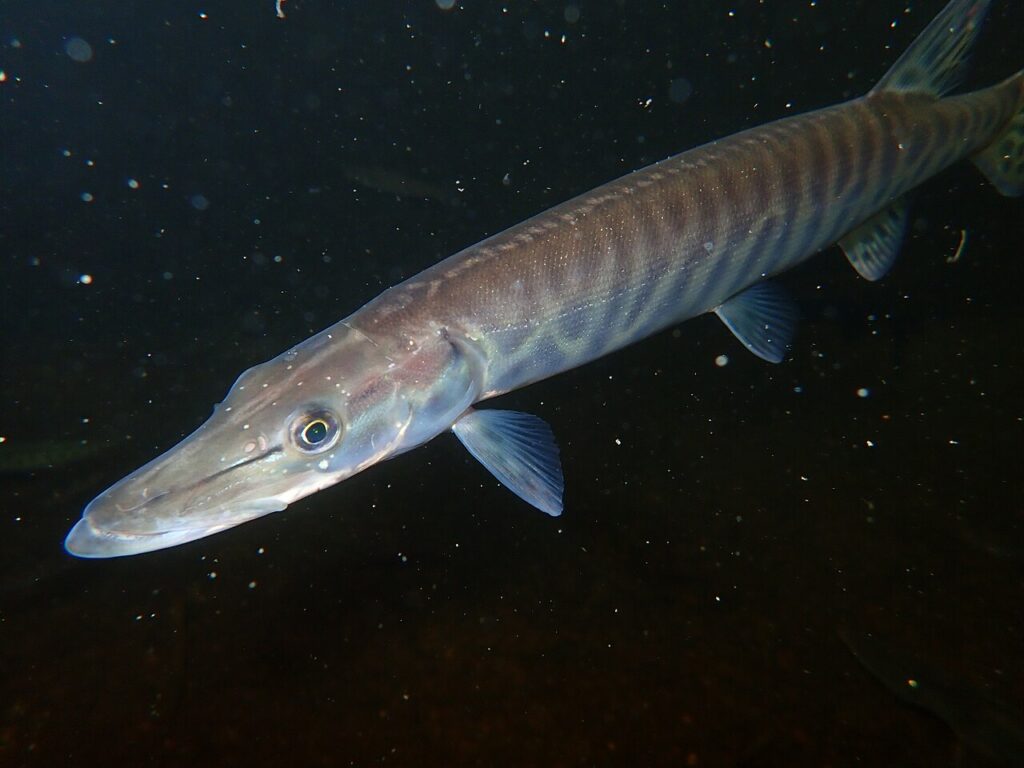
The tiger muskie is a cross between a muskellunge and a northern pike. It has bold dark stripes, grows fast and cannot reproduce, which lets state agencies stock it as a trophy fish in lakes where a breeding population of muskies or pike would not be wanted. Like both parents, it is a hard fish to fool.
- Scientific nameEsox masquinongy × E. lucius
- Also calledTiger musky, tiger muskellunge
- Typical catch28 to 40 inches, 6 to 18 lb
- Trophy45 inches or 25 lb and up
- World record51 lb 3 oz
- SpawnsNo. Sterile hybrid
How to identify a tiger muskie
- The stripes. Dark, wavy vertical bars on a light green or silver side, often breaking into spots toward the tail. This tiger pattern is the best single mark.
- The tail. The tips of the tail are rounded, like a pike. A pure muskie has pointed tail tips.
- The fins. Fins are often reddish with dark spots or bands.
| Tiger muskie | Muskellunge | Northern pike | |
|---|---|---|---|
| Markings | Dark bars on a light side | Dark bars or spots on a light side, or plain | Light oval spots on a dark side |
| Tail tips | Rounded | Pointed | Rounded |
| Cheek scales | Upper half, sometimes more | Upper half only | Whole cheek |
| Breeds | No | Yes | Yes |
How big do they get?
Tiger muskies grow quickly, and most caught are 28 to 40 inches. A fish of 45 inches or 25 pounds is a trophy anywhere. The IGFA all-tackle world record is 51 pounds 3 ounces, caught in Lac Vieux Desert on the Wisconsin and Michigan border on July 16, 1919.
Where they live
A few tiger muskies occur naturally where muskies and pike share a lake, but nearly all are hatchery fish. States that stock them include Washington, Idaho, Utah, Colorado, New Mexico, Minnesota and New York, among others. Check your state stocking list for the exact lakes.
Where to look
The outside edge of weed beds, points, sunken timber and the first drop into deeper water. They hold alone and ambush from cover.
Why agencies stock them
They are sterile, so numbers stay exactly where the agency sets them. Many are stocked to thin out stunted panfish or rough fish while giving anglers a trophy to chase.
Tiger muskies are sometimes stocked in private lakes to thin out stunted panfish, because they cannot breed and their numbers stay where the owner sets them. Stocking them usually needs a state permit. If a host lists tiger muskies, expect catch and release, and bring a leader and a large net.
What they eat
Other fish, and large ones: suckers, perch, panfish, trout and whatever soft-finned fish is most common in the lake. A tiger muskie can swallow a fish a third of its own length.
Season by season
| Season | Where the fish are | What to throw |
|---|---|---|
| Spring (50 to 60°F) | Shallow, dark-bottomed bays that warm first | Smaller lures worked slowly: jerkbait, spinnerbait |
| Summer (65 to 78°F) | Weed edges and points early and late. Deeper breaks at midday | Large inline spinner, prop bait on top at dusk |
| Fall (cooling to 50°F) | Steep breaks near the last green weeds. The best time for the biggest fish | Glide bait, large soft swimbait, worked slowly |
| Winter | Deep and slow | Few are caught |
Best lures for tiger muskie
| Lure | Why it works | Use it when |
|---|---|---|
| Large inline spinner | Easy to fish and covers water. The standard muskie lure | Summer, over and along weeds |
| Glide bait | Wide side-to-side swing with pauses that trigger following fish | Cool water in spring and fall |
| Large soft swimbait | Can be fished at any depth and speed | Deep breaks in fall |
| Topwater prop bait | Steady surface noise a fish can track | Calm evenings in summer |
Tiger muskies follow lures to the boat. Before lifting the lure out, push the rod tip into the water and sweep it in a wide figure eight. Many fish strike right there.
Starter gear
| Item | What to use |
|---|---|
| Rod | 8 ft heavy or extra-heavy casting rod |
| Reel | Large baitcasting reel, 300 or 400 size |
| Line | 65 to 80 lb braid |
| Leader | 12 inches of wire or 100 lb fluorocarbon. Teeth cut anything lighter |
| Also bring | A large rubber net, long-nose pliers, hook cutters and jaw spreaders |
Handling and rules
- Keep the fish in the net, in the water. Unhook it there. Cut hooks that are hard to reach.
- Hold it level. For a quick photo, one hand under the jaw plate and one under the belly. Never hang a big fish by the jaw.
- Stop in hot water. Above about 80°F a long fight can kill a muskie even if it swims off. Fish for something else on those days.
- Expect to release it. Size limits are high because each fish costs a lot to raise. Washington, for example, sets a 50 inch minimum and a limit of one. Check your state rules.
Common questions
Is a tiger muskie a real muskie?
It is half muskie and half northern pike. It grows nearly as large as a muskie and is fished for the same way.
Can tiger muskies reproduce?
No. They are sterile. Every lake that holds them has to be restocked.
How do I tell a tiger muskie from a pike?
Look at the pattern. A pike has light spots on a dark body. A tiger muskie has dark bars on a light body.
Are they dangerous to swimmers?
No. The danger is to your hands while unhooking one. Use long pliers and keep fingers away from the teeth and gills.
Keep learning
Sources: International Game Fish Association all-tackle world record (51 lb 3 oz, Lac Vieux Desert, 1919); Washington Department of Fish and Wildlife tiger muskie rules; state fisheries agency species profiles. General guidance, not a guarantee of a catch. Follow state fishing regulations and your host’s lake rules.